
Build Your Outbound Engine Without a Complicated Sales Stack
Find prospects, launch campaigns, manage conversations, and understand what's working from one place — without building a complicated sales operation.
- Live in an afternoon
- No infrastructure to configure
- Conversations and pipeline in one view
Still doing outbound manually between everything else you have to run?
Founder-led outbound works — right up to the point where product, hiring and customers take the week, and the sending stops.
Limited time
Outreach competes with every other job you own, so it happens in bursts and then stops for a month.
Manual prospecting
Finding contacts one at a time is slow, and the list you built in January is already out of date.
Campaign setup
Evaluating tools, connecting domains and configuring sending is a project on its own before a single email goes out.
Follow-up
You know the replies come from touch two and three, and those are the ones that never get sent.
Reply management
Answers mix into the same inbox as investors, support and suppliers, and some go cold.
Lack of visibility
Without numbers you cannot tell whether outbound is not working or simply not running.
The whole outbound loop in one place
Leads, campaigns, sequences, sending accounts, scheduling, warmup, the unified inbox, replies, analytics, CRM and automations, set up once, so outbound keeps going on the weeks you cannot touch it.
Set up in an afternoon
Import a list, write a sequence, connect a mailbox and launch.
No infrastructure work
Scheduling, throttling and warmup are handled for you.
Follow-ups by default
Touch two and three happen without you remembering them.
Outbound replies separated
Prospect conversations in their own inbox, away from everything else.
Straight answers
Simple numbers on sends, replies and positive replies so you know where you stand.
From prospect to conversation
Seven steps, in the order you would actually do them. Each one happens in the same workspace, so nothing has to be exported, re-imported or reconciled between tools.
Build your prospect list
Start from the people worth talking to. Import a CSV, map your own columns and let duplicates and previously suppressed addresses drop out on the way in. The list becomes a reusable source rather than a one-off file.
Organize your leads
Segment the list by the fields that change your message — role, industry, region, company size. Clean segments are what make personalization possible later, and they let you compare performance between audiences afterwards.
Create your sequence
Write the opening email and the follow-ups that come after it. Personalization variables pull from your imported fields, and fallbacks keep the sentence intact when a value is missing. Every step has its own delay.
- Intro emailSent · Day 0
- Wait 3 daysNo reply detected
- Follow-up #1Scheduled · Tue 09:15
- Reply receivedSequence stops automatically
Connect your sending accounts
Add the mailboxes the campaign will send from and set a daily limit for each. Warmup runs in the background, and health status tells you when an account should carry less volume for a while.
Schedule your campaign
Choose the time zone, the sending window, the daily cap, the hourly maximum and the delay between messages. The scheduler spreads the day's volume across your accounts instead of firing everything at once.
Manage replies
Answers arrive in the unified inbox with the full thread and the prospect record attached. Remaining follow-ups stop automatically for anyone who replies, bounces or unsubscribes, so nobody gets chased after answering.
Sounds interesting — can you…
Who handles this on your side?
Not right now, thanks.
Measure performance
Track sends, deliveries, replies, positive replies and unsubscribes per campaign, per segment and per sending account — so the next campaign is built on what happened in the last one.
Everything you need without a complicated sales stack
The short list of things founder-led outbound actually depends on.
Prospect management
Import your target list, map fields and keep it in one place you can reuse.
Simple campaign setup
Create a campaign, pick the audience, set the schedule and launch.
Sequences
An opener and a couple of follow-ups, personalized from your own data.
Follow-ups
Scheduled touches that stop the moment someone answers.
Unified inbox
Every prospect reply in one thread view, separate from your main mailbox.
Analytics
Sends, deliveries, replies and positive replies, without a reporting project.
One workspace for your entire outbound operation
Campaigns, leads, sending accounts, the inbox, analytics, CRM and warmup are parts of the same product — not integrations you have to keep in sync.
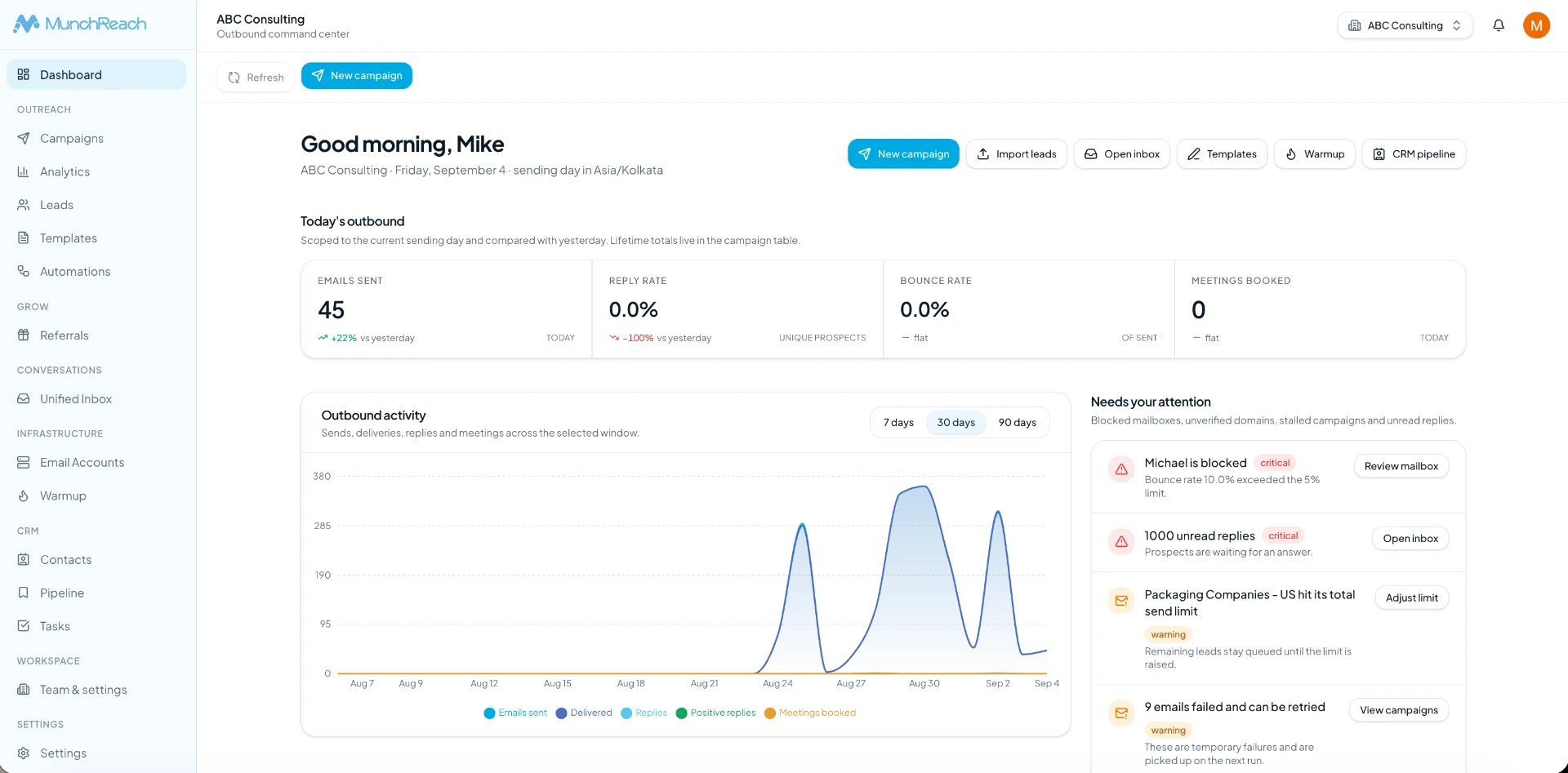
Campaigns
Every campaign with its audience, sequence, schedule and current state.
Leads
Imported, deduplicated and segmented contact data feeding those campaigns.
Sending accounts
Connected mailboxes with daily limits, health and capacity in view.
Inbox
Replies from every campaign and mailbox in one shared thread list.
Analytics
Delivery, reply and positive-reply performance you can act on.
CRM
Statuses, owners and notes carrying conversations to an outcome.
Warmup
Sending reputation built and maintained in the background.
See the product behind the workflow
Real MunchReach interfaces, in the order an outbound team touches them.
Set the campaign up once, then let it run
A campaign holds everything that decides what goes out and when: the audience, the sequence, the sending accounts and the schedule. Change one of them and the plan for the coming days is rebuilt around it.
- Multi-step sequences with per-step delays
- Time zone, sending window and daily cap per campaign
- Hourly maximum and randomized delay between sends
- Follow-ups cancelled on reply, bounce or unsubscribe
Keep sending capacity visible and under control
Volume is limited by the mailboxes behind it. Every connected account shows its daily limit, how much of it is used and whether it is healthy enough to keep sending today.
- Per-account daily limits and hourly caps
- Health status before capacity becomes a problem
- Volume spread across accounts automatically
- Warmup running in the background
Every reply in one thread list
Replies from every campaign and every mailbox land in one place, with the exact message that was sent, the full thread, the prospect record and any notes your team added.
- The sent email exactly as the prospect received it
- Assign conversations and leave internal notes
- Reply without switching mailboxes
- Status updates that flow through to the CRM
Sounds interesting — can you…
Who handles this on your side?
Not right now, thanks.
Numbers that tell you what to change
Delivery, reply and positive-reply performance per campaign, segment and sending account — the three levels where outbound is usually fixed.
- Sends, deliveries, replies and unsubscribes over time
- Positive replies tracked separately from raw replies
- Performance compared between campaigns
- Mailbox-level view when delivery drops
Sending reputation maintained quietly
New mailboxes ramp gradually and established ones keep a steady background pattern, so a campaign is not the first serious traffic an account has ever sent.
- Gradual ramp for new accounts
- Ongoing activity for established mailboxes
- Visible per-account warmup status
- Nothing to configure per campaign
How a founder runs MunchReach
Set it up once, then spend your outbound time on conversations instead of admin.
- 1
Target market
Decide who you want to talk to this quarter.
- 2
Leads
Import the list and clean it on the way in.
- 3
Campaign
One sequence, one audience, one schedule.
- 4
Follow-ups
Let the scheduled touches do the chasing.
- 5
Replies
Work answers from the inbox between other jobs.
- 6
Pipeline
Track which conversations turn into real deals.
What changes once outbound lives in one place
No promises about reply rates or meetings — those depend on your offer and your list. What MunchReach changes is the operation around them.
- Less operational overhead
- No stack to assemble and no infrastructure to maintain.
- Simpler outbound workflow
- One screen for prospects, campaigns, replies and numbers.
- Centralized conversations
- Prospect threads separated from the noise of a founder inbox.
- Better visibility
- You can tell whether outbound is working, and act on it.
Without MunchReach
- Outbound in bursts, then silence
- Contacts spread across tools
- Follow-ups skipped
- No numbers to judge it by
With MunchReach
- A campaign that keeps running
- One prospect list you reuse
- Follow-ups on schedule
- Clear reply performance
Why MunchReach?
One platform
Manage the moving parts of outbound from one workspace instead of stitching tools together.
Unified inbox
Prospect conversations stay together, with the exact message that was sent attached to the thread.
Multiple sending accounts
Sending infrastructure is managed centrally, with limits, health and warmup per account.
Campaign control
Schedules, sequences, sending windows and daily limits are yours to set per campaign.
Analytics
Delivery, reply and positive-reply performance at campaign, segment and mailbox level.
Built for outbound
The product is designed around the operational workflow of outbound teams, not adapted from a generic mail tool.
Frequently Asked Questions
Everything you need to know about MunchReach.
Ready to take outbound off your manual to-do list?
Launch your first campaign today and let follow-ups run while you build.